
Fast Track Degree Courses in India: Eligibility, Validity & Best Options
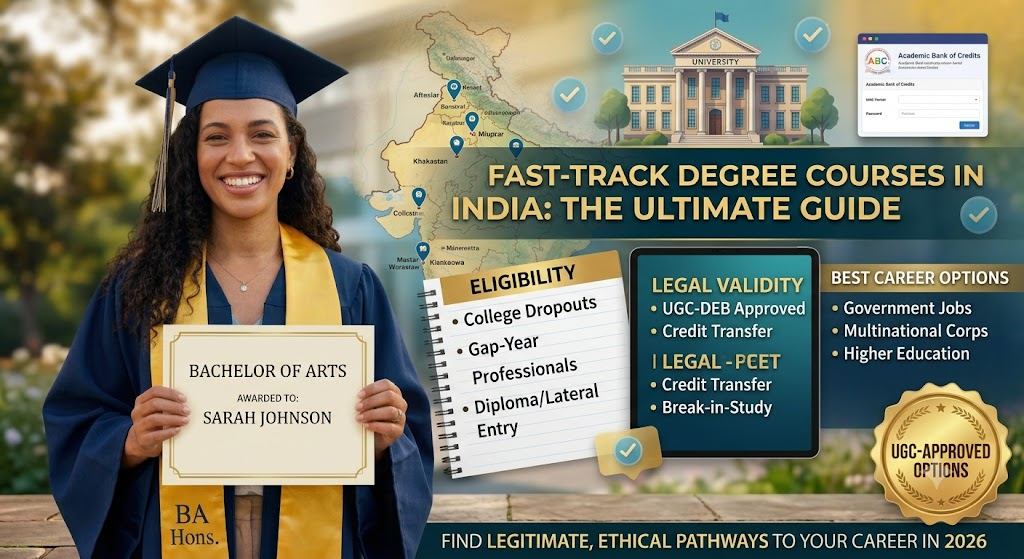
For students and working professionals, completing a degree quickly can be an attractive option. People with education gaps, demanding work schedules, or unfinished college studies often search for fast track degree courses in India, one-year degree courses, accelerated graduation programmes, and flexible online or distance education options.
The idea of completing a degree faster can be appealing, but students should be careful about programmes advertised as “fast track,” “one sitting,” or “degree in one year.” The duration and validity of a qualification depend on the university, programme, academic requirements, learning mode, and applicable regulations.
A fast-track course should therefore be evaluated on more than its completion time. Before admission, students should understand what qualification they will receive, who will award it, whether the programme is recognised, and whether it meets their future career or education requirements.
What Are Fast Track Degree Courses?
Fast track degree courses generally refer to programmes marketed as providing a quicker or more flexible route toward completing higher education.
The phrase “fast track” does not by itself establish that a degree is recognised. A university may offer flexible learning, online education, credit-based pathways, or other academic arrangements, but the exact structure and duration must comply with applicable requirements.
This distinction is particularly important when an advertisement promises a degree in one year.
A student should ask:
-
What university awards the degree?
-
What is the official duration?
-
What are the eligibility requirements?
-
How many credits are required?
-
What examinations and assessments must be completed?
-
Is the programme regular, online, or distance?
-
Is the programme currently recognised or entitled under the relevant framework?
-
Will the qualification meet the requirements for the student's intended purpose?
These questions can help separate a legitimate flexible programme from an unverified fast-track offer.
Can You Complete a Degree in One Year?
This is one of the most common questions associated with one-year degree courses in India.
Students should not assume that a conventional bachelor's degree can simply be compressed into 12 months. Degree programmes have academic structures, minimum requirements, credits, assessments, and examinations.
The UGC maintains regulations covering minimum standards for undergraduate and postgraduate degrees, as well as separate regulations for Open and Distance Learning and online programmes. Its current regulations database includes the 2025 Minimum Standards of Instruction for the Grant of Undergraduate Degree and Postgraduate Degree Regulations and the 2024 third amendment to the ODL and Online Programmes Regulations.
This means that the words “one year degree” should never be treated as proof of validity.
If a provider claims that a standard bachelor's programme can be completed in one year, students should request official information explaining the programme's duration, academic structure, and regulatory basis.
Fast Track Degree vs One Sitting Degree
These terms are sometimes used interchangeably, but they should not automatically be treated as the same.
Fast Track Degree
A fast-track programme may describe a flexible or accelerated academic pathway, depending on the university and applicable rules.
One Sitting Degree
A one sitting degree is generally advertised as a qualification that can be completed through examinations or academic formalities in a single sitting or a very short period.
Students should be particularly cautious with one-sitting advertisements because the terminology itself does not establish recognition.
The UGC's current framework focuses on the recognition and academic requirements of degree programmes rather than simply whether an institution advertises a course as “fast track.”
Are Fast Track Degree Courses Valid in India?
There is no universal answer based solely on the words “fast track.”
The validity of a degree depends on factors including:
-
The legal status of the awarding university
-
The specific degree
-
The programme structure
-
The mode of education
-
Applicable UGC regulations
-
Required approvals from relevant statutory or regulatory bodies
-
Admission and examination requirements
-
The purpose for which the qualification will be used
The UGC states that a statutory university can award a degree specified under Section 22 of the UGC Act, subject to approval from its competent and statutory councils where required and compliance with UGC regulations.
Therefore, a student should not rely only on a private institute's claim that a course is “UGC approved.”
The exact university and programme should be independently verified.
Fast Track Degree Courses After 12th
Students who have completed Class 12 may want a degree that fits their career plans without requiring traditional campus attendance.
Depending on eligibility, students can explore bachelor's programmes in areas such as:
-
Bachelor of Arts (BA)
-
Bachelor of Commerce (B.Com)
-
Bachelor of Business Administration (BBA)
-
Bachelor of Science (B.Sc.)
-
Bachelor of Computer Applications (BCA)
-
Other undergraduate disciplines offered by recognised institutions
The availability of programmes through online or distance modes varies by university and subject.
Students should check the specific programme rather than assuming that every course is available through every learning mode.
For example, a student interested in business may consider a BBA, while someone interested in humanities may prefer a BA. A student interested in accounting or commerce may explore B.Com.
The best degree is the one that matches both your eligibility and long-term career objective.
Fast Track Graduation for Working Professionals
Working professionals are one of the largest audiences searching for fast track graduation courses.
Someone working full-time may find it difficult to attend a conventional college every day. Flexible education can make it possible to continue working while pursuing higher education.
Before selecting a programme, compare:
-
Class or lecture schedule
-
Online learning facilities
-
Examination requirements
-
Programme duration
-
Fees
-
Student support
-
Academic resources
-
Recognition
-
Career relevance
-
Further-study eligibility
A properly recognised online or distance programme may provide greater flexibility without requiring students to leave employment.
However, flexibility should not be confused with the elimination of academic requirements.
Online Degree Courses as a Flexible Option
Online degree courses have become an important option for students who need flexibility.
The UGC maintains a dedicated regulatory framework for ODL and online programmes. Its regulations page lists the 2020 regulations and subsequent amendments, including the 2024 third amendment.
Students considering an online degree in India should verify the university and programme for the relevant academic session.
The UGC has specifically warned students about admission to unrecognised ODL and online programmes. In a 2024 public notice, it stated that students should enrol only in approved higher education institutions and introduced a DEB-ID requirement for new ODL and online admissions from the specified academic session onward.
This makes official verification especially important.
Distance Degree Courses in India
Open and Distance Learning can be another option for students who cannot attend campus regularly.
A distance degree allows learners to follow an academic programme while managing work, family responsibilities, or other commitments.
However, distance education is not the same as obtaining a degree without studying.
Students may still have to complete:
-
Coursework
-
Assignments
-
Credits
-
Examinations
-
Practical or other programme-specific requirements
-
University formalities
The UGC advises students to confirm the recognition status of the higher education institution for the specific academic session in which they intend to enrol. It also notes that recognition in one year does not automatically establish recognition for a subsequent session.
Popular Fast Track Degree Options
When searching for fast track degree courses in India, students commonly look at several undergraduate fields.
BA – Bachelor of Arts
A BA can be suitable for students interested in humanities, social sciences, communication, public administration, education, and related areas.
Depending on the university, subjects may include English, History, Political Science, Sociology, Economics, and other disciplines.
B.Com – Bachelor of Commerce
B.Com is often considered by students interested in accounting, finance, commerce, taxation, banking, and business.
BBA – Bachelor of Business Administration
BBA can be useful for students interested in management, marketing, business operations, entrepreneurship, and related fields.
BCA – Bachelor of Computer Applications
BCA is generally aimed at students interested in computer applications, software, programming, databases, and information technology.
B.Sc. – Bachelor of Science
B.Sc. programmes cover a wide range of subjects, including science and technology-related disciplines. Eligibility and subject requirements depend on the programme.
The availability of these programmes through online and distance modes should always be verified with the university and relevant regulatory information.
Fast Track Degree After an Education Gap
An education gap is one of the main reasons students search for accelerated degree options.
A student may have completed Class 12 but never attended college. Another may have started graduation and discontinued it because of employment, financial circumstances, family responsibilities, or relocation.
An education gap does not necessarily mean that you need a one-sitting or questionable fast-track degree.
Depending on eligibility, you may be able to apply for a recognised bachelor's programme through regular, online, or ODL mode.
If you previously completed part of a degree, ask your university about applicable credit transfer, re-entry, migration, or other academic options. The availability of such pathways depends on the institution and current rules.
How to Check Whether a Fast Track Degree Is Genuine
Before paying admission fees, complete these checks.
1. Verify the University
Start with official UGC information and the university's own documentation.
Do not rely solely on an education consultant's website, social media advertisement, or WhatsApp message.
2. Check the Exact Degree
Confirm the exact name of the qualification and the university that awards it.
The UGC publishes a list of specified degrees and explains the legal framework under which universities may award degrees.
3. Check the Programme
University recognition does not mean that every programme or every mode is automatically available under the same conditions.
Verify the specific programme.
4. Check the Learning Mode
Determine whether the programme is:
-
Regular
-
Online
-
Open and Distance Learning
If you choose online or distance education, check the current recognition or entitlement for the relevant session.
5. Check the Duration
Ask for the official programme duration in writing.
If an agent claims that a programme can be completed substantially faster than the duration published by the university, request documentary evidence.
6. Check the Examination Process
Find out how examinations are conducted and what assessments must be completed.
Be cautious if a provider says that no study, coursework, assessment, or examination is required.
7. Check Future Acceptance
Think about where you will use the qualification.
You may need it for:
-
Private employment
-
Government recruitment
-
Promotion
-
Postgraduate admission
-
Professional education
-
Career change
Acceptance can depend on the requirements of the employer, university, regulator, or recruiting authority.
Red Flags to Avoid
Students searching for fast track degree courses should be cautious about certain claims.
“Degree in One Exam”
A bachelor's degree is an academic qualification. A promise to award a degree after one examination should be investigated carefully.
“No Classes or Study Required”
Flexible education may reduce classroom attendance, but it does not necessarily eliminate academic requirements.
“Instant Degree Certificate”
A claim that a degree can be issued immediately without completing the relevant programme is a major warning sign.
“Backdated Degree”
Students should avoid offers involving backdated qualifications unless the legal and academic basis is independently established.
“Guaranteed Government Job Validity”
A private education provider cannot be assumed to guarantee acceptance by every government recruitment authority.
“UGC Approved” Without Programme Details
Ask for the university name, programme name, mode, academic session, and official recognition information.
What Is the Difference Between a Degree and a Diploma?
Students often use the terms degree and diploma interchangeably, but they are different qualifications.
The UGC states that diploma and certificate courses are not specified by the UGC in the same way as degrees, although universities may run diploma and certificate courses subject to their governing or statutory approvals where required.
A bachelor's degree is a higher education qualification awarded under the applicable degree framework.
Therefore, if an advertisement says “fast track degree or diploma,” confirm exactly which qualification you will receive.
This distinction can matter when applying for employment or higher education.
Is a Fast Track Degree Better Than a Regular Degree?
Not necessarily.
A regular degree offers a traditional academic structure, campus learning, direct interaction with faculty, and a defined programme duration.
A flexible online or distance degree can be more convenient for working professionals.
A fast-track programme may appear attractive because of its shorter advertised duration, but the qualification's value depends on recognition and academic validity.
The best choice depends on your circumstances.
If you can attend college and want a traditional university experience, a regular degree may be appropriate.
If you work full-time, an approved online or ODL programme may be more practical.
If you are considering an accelerated route, verify its academic and regulatory basis before admission.
What Should Working Professionals Consider?
If you are employed and looking for fast track graduation for working professionals, consider the following:
Flexibility: Can you study outside working hours?
Examinations: Are examination dates compatible with your job?
Programme duration: Is the advertised duration officially documented?
Recognition: Is the university and programme appropriately recognised for the intended mode?
Cost: What is the total cost, including examination and other fees?
Career relevance: Does the degree support your intended career?
Further studies: Will the qualification meet the admission requirements of your future programme?
This checklist can help you make a decision based on long-term value rather than advertising language.
Can You Pursue Two Degrees Simultaneously?
Students interested in completing education more efficiently may also consider the UGC framework for pursuing two academic programmes simultaneously.
The UGC currently lists guidelines for pursuing two academic programmes simultaneously and a partial modification issued in 2025.
This is different from completing one bachelor's degree in a single sitting.
If you are interested in studying two programmes, check the current UGC guidelines and the rules of the universities involved before admission.
What Is the Best Fast Track Degree Course?
There is no single “best” fast-track degree for everyone.
Your choice should depend on your previous education and career plans.
For example:
-
BA may suit students interested in humanities and social sciences.
-
B.Com may suit commerce and finance-oriented learners.
-
BBA may suit students interested in business and management.
-
BCA may suit learners interested in computer applications and IT.
-
B.Sc. may suit students interested in science-related subjects.
Instead of choosing a course solely because it promises fast completion, consider whether the subject is relevant to your future.
Frequently Asked Questions
Are fast track degree courses valid in India?
Validity depends on the specific university, degree, programme, mode of education, and applicable regulations. The term “fast track” alone does not establish recognition.
Can I get a degree in one year?
Do not assume that a conventional bachelor's degree can be completed in one year. Check the official programme duration and applicable academic requirements.
What are the best alternatives to one sitting degrees?
Recognised regular, online, and Open and Distance Learning programmes may provide legitimate routes depending on your eligibility and circumstances.
Can working professionals pursue an online degree?
Yes, eligible working professionals can explore recognised online programmes that offer flexible learning. Always verify the university and programme before admission.
Is a distance degree recognised?
A distance degree can be recognised when it is offered by an institution and programme with the appropriate recognition or entitlement for the relevant academic session. The UGC specifically advises students to check session-specific recognition before admission.
How can I verify my degree?
The UGC notes that verification of an individual degree, diploma, or certificate is the responsibility of the issuing university or institution, while UGC can provide recognition status information for the institution or programme.
Conclusion
Fast track degree courses in India can be attractive to students who want to complete higher education quickly, particularly working professionals and learners with education gaps. However, students should not choose a programme based solely on promises such as “one year degree,” “single sitting,” or “instant graduation.”
The most important factors are the university, exact degree, programme structure, academic duration, learning mode, recognition, examinations, and future acceptance.
For students who need flexibility, recognised online and distance degree courses may be worth considering. The UGC has an established regulatory framework for ODL and online programmes and advises students to verify recognition for the specific academic session before enrolling.
Before paying any admission fee, independently verify the institution and programme, read the official admission information, and confirm that the qualification meets your intended career or education requirements.

 English
 Arabic
 French
 Spanish
 Portuguese
 Deutsch
 Turkish
 Dutch
Dutch
 Italiano
 Russian
 Portuguese (Brazil)
 Greek
Greek
