
Online Brokers and Trading Platform Market: Rising Mobile Investing, Automation & Global Market Access
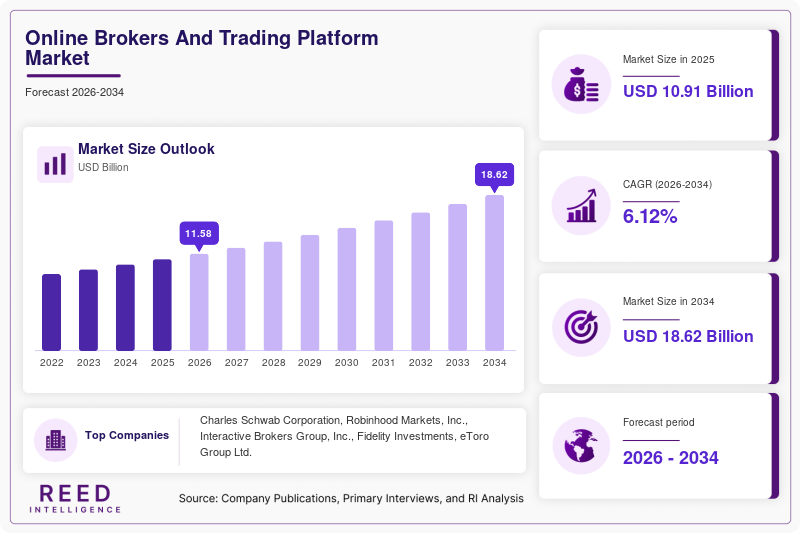
Online Brokers and Trading Platform Market Size, Share & Trends Analysis Report 2026–2034
Market Overview
The Online Brokers and Trading Platform Market was valued at USD 10.91 billion in 2025 and is projected to grow from USD 11.58 billion in 2026 to USD 18.62 billion by 2034, registering a CAGR of 6.12% during the forecast period from 2026 to 2034.
The market is shifting from basic digital order execution toward broader, multi-asset financial platforms that combine trading, investing, cash management, research, advisory, and wealth-management functions. Electronic execution, lower transaction costs, and mobile access have reduced barriers to market participation, while platform providers are expanding the range of assets and services available through a single account.
Request Sample Link:
https://reedintelligence.com/market-analysis/online-brokers-and-trading-platform-market/request-sample
Market Size and Forecast
The Online Brokers and Trading Platform Market is projected to reach USD 18.62 billion by 2034 from USD 11.58 billion in 2026, expanding at a CAGR of 6.12% during 2026–2034.
Market development is supported by the increasing adoption of digital brokerage services, broader retail-investor participation, multi-asset platforms, mobile investing, automated investing, and the integration of financial services. Platform providers are increasingly combining trading with advisory, wealth management, retirement, banking, and other services.
The market is also being shaped by the expansion of digital-first brokerage platforms and established financial institutions. Robinhood ended 2025 with 27.0 million funded customers and USD 324 billion in platform assets, while eToro reported 3.81 million funded accounts and USD 18.5 billion in assets under administration.
Market Drivers
Mobile-First Investing Is Expanding Retail Access
The increasing use of mobile applications is changing how retail investors interact with brokers. Mobile platforms allow users to monitor portfolios, deposit funds, receive market information, and execute trades through a single interface.
This shift encourages brokers to compete through interface design, education, alerts, fractional investing, and integrated financial services. The trend is particularly relevant to retail investors and younger account holders, although digital engagement practices remain subject to regulatory scrutiny.
Multi-Asset Platforms Increase Customer Opportunities
Online brokers are broadening access to multiple asset classes through digital accounts. Interactive Brokers provides access to more than 160 markets, while eToro combines equities, ETFs, cryptoassets, and other investment products.
The availability of multiple asset classes can support customer retention by reducing the need for investors to maintain several brokerage relationships. eToro reported that 53% of its funded accounts invested in more than one asset class at the end of 2025.
Automation and AI Are Expanding Platform Capabilities
Online brokers are incorporating automation, intelligent search, personalized information, and AI-supported investing tools. Automated investing and digital advisory services can increase engagement among customers who do not actively trade, while AI-supported research and discovery tools can expand activity within digital platforms.
These developments also introduce requirements related to suitability, transparency, data security, and investor protection.
Market Challenges
Margin Pressure From Low-Cost Trading
The widespread elimination of trading commissions has reduced one traditional revenue source for retail brokerage platforms. Brokers increasingly need to generate revenue through deposits, securities lending, margin lending, subscriptions, premium products, payment services, and other activities.
Regulatory and Cybersecurity Requirements
Digital brokers operate in highly regulated financial markets. Electronic order handling, market access, customer protection, data management, cybersecurity, identity verification, risk controls, and regulatory reporting increase operating requirements.
The speed and automation of electronic trading can also increase the consequences of trading errors or malicious activity, requiring continued investment in resilient infrastructure and compliance systems.
Market Opportunities
Integrated Financial Super-Apps
The expansion of brokerage platforms into banking, retirement, cash management, advisory, and alternative investments creates opportunities to increase the amount of a customer's financial activity handled through one provider.
Robinhood's 2025 results demonstrate this expansion. Its Gold subscriber base reached 4.2 million, while Robinhood Retirement assets under custody more than doubled year over year to USD 26.5 billion.
International Market Access
Global market access provides another opportunity for online brokers to differentiate their services. Interactive Brokers offers access to more than 160 markets, while eToro expanded access to HKEX-listed stocks and exchange-traded products in 2025.
Localized products, tax-advantaged accounts, and regional partnerships can support broader market penetration, although international expansion also increases licensing, tax, custody, currency, and regulatory complexity.
Market Segmentation
The Online Brokers and Trading Platform Market is segmented by Platform Type, Service Type, Asset Class, End User, and Region.
By Platform Type
Mobile Trading Applications
Mobile Trading Applications accounted for approximately 47% of the platform-type segment in 2025. Their position reflects the shift toward continuous portfolio monitoring and mobile-first investing.
Mobile applications combine trading, account funding, portfolio monitoring, alerts, educational content, and financial-management features within one interface.
Web-Based Platforms
Web-Based Platforms accounted for approximately 36% of the platform-type segment in 2025 and are projected to grow at approximately 5.7% CAGR through 2034. Web interfaces remain important for detailed portfolio information, research tools, and larger-screen trading functionality.
Desktop Trading Platforms
Desktop Trading Platforms accounted for the remaining 17% and are projected to grow at approximately 4.9% CAGR through 2034. Demand is concentrated among active and professional users requiring advanced charting, execution, and analytical capabilities.
By Service Type
Self-Directed Trading accounted for approximately 55% of the service-type segment in 2025. Automated Investing represented approximately 25% and is projected to grow at approximately 9.4% CAGR through 2034. Advisory & Wealth Management accounted for approximately 20% and is projected to grow at approximately 7.8% CAGR.
By Asset Class
Equities accounted for approximately 39% of the asset-class segment in 2025. Cryptocurrencies accounted for approximately 14% and are projected to grow at approximately 11.8% CAGR through 2034.
ETFs are projected to grow at approximately 7.2%, Options & Futures at 7.0%, Bonds at 5.8%, and Other Assets at approximately 6.5% through 2034.
By End User
Retail Investors accounted for approximately 61% of the end-user segment in 2025. Active Traders accounted for approximately 24% and are projected to grow at approximately 7.4% CAGR through 2034. Institutional Investors accounted for approximately 15% and are projected to grow at approximately 5.2% CAGR.
Regional Analysis
North America
North America accounted for approximately 38% of global revenue in 2025 and is projected to grow at approximately 5.7% CAGR through 2034. The region benefits from mature electronic trading infrastructure, a large retail-investor population, and competition among full-service and digital-first brokers.
Charles Schwab reported nearly USD 12 trillion in assets and more than 46 million client accounts in 2025, while daily average trades reached 7.7 million, up 31% from 2024.
Asia-Pacific
Asia-Pacific accounted for approximately 28% of global revenue in 2025 and is projected to grow at approximately 7.6% CAGR through 2034. Growth is supported by expanding retail-investor participation, smartphone adoption, digital financial services, and increasing access to domestic and international securities.
Europe
Europe accounted for approximately 21% of global revenue in 2025 and is projected to grow at approximately 5.9% CAGR through 2034. The region combines mature investment markets with demand for digital platforms offering equities, ETFs, cryptoassets, savings products, and tax-advantaged accounts.
Latin America
Latin America accounted for approximately 8% of global revenue in 2025 and is projected to grow at approximately 6.8% CAGR through 2034. Growth is developing around mobile investing, increasing retail participation, and demand for accessible investment products.
Middle East & Africa
Middle East & Africa accounted for approximately 5% of global revenue in 2025 and is projected to grow at approximately 6.3% CAGR through 2034. Adoption is concentrated in markets with developed financial centers, rising digital-finance penetration, and demand for international investment access.
Key Players
-
Charles Schwab Corporation
-
Robinhood Markets, Inc.
-
Interactive Brokers Group, Inc.
-
Fidelity Investments
-
eToro Group Ltd.
-
E*TRADE
-
Webull Corporation
-
IG Group Holdings plc
Other market participants include Saxo Bank, Plus500 Ltd., Trading 212, Futu Holdings Limited, Moomoo Technologies Inc., Ally Invest, and SoFi Technologies, Inc.
Competition is increasingly centered on customer assets, product breadth, execution quality, technology, pricing, and integrated financial services. Established brokers such as Charles Schwab compete through scale, asset coverage, wealth-management capabilities, and customer relationships, while digital-first platforms focus on simplified interfaces, rapid product development, and broader access to alternative assets.
Conclusion
The Online Brokers and Trading Platform Market is projected to grow from USD 11.58 billion in 2026 to USD 18.62 billion by 2034, registering a CAGR of 6.12% during 2026–2034. Mobile-first investing, multi-asset platforms, automation, AI-supported tools, and integrated financial services are shaping the development of the market.
Mobile Trading Applications accounted for approximately 47% of the platform-type segment in 2025, while Self-Directed Trading represented approximately 55% of the service-type segment. Retail Investors accounted for approximately 61% of the end-user segment. North America represented approximately 38% of global revenue in 2025, while Asia-Pacific is projected to grow at approximately 7.6% CAGR through 2034.
The Online Brokers and Trading Platform Market continues to develop through expanding digital access, broader asset coverage, automated investing, wealth-management integration, and international market access.
Report Link:
https://reedintelligence.com/market-analysis/online-brokers-and-trading-platform-market

 English
 Arabic
 French
 Spanish
 Portuguese
 Deutsch
 Turkish
 Dutch
Dutch
 Italiano
 Romaian
 Portuguese (Brazil)
 Greek
Greek
