
How does Ophthalmic Modular OT With Laminar Airflow help control contamination?
INTRODUCTION
An Ophthalmic Modular OT With Laminar Airflow is designed to support a controlled surgical environment by combining modular operation theatre construction with engineered airflow, HEPA filtration, HVAC control, and contamination-control features. Ophthalmic procedures require precision and a carefully controlled environment because the surgical field involves delicate eye tissues. Airborne particles, microorganisms, personnel movement, unsuitable surfaces, and uncontrolled airflow can contribute to contamination risks. A properly designed modular ophthalmic OT helps address these factors through controlled ventilation, pressure management, cleanable surfaces, appropriate zoning, and validated environmental performance.
Why Is Contamination Control Important in Ophthalmic OTs?
Contamination control is an important part of operation theatre planning because airborne particles can originate from people, clothing, equipment, surfaces, and other activities inside the room.
India's National Guidelines for Infection Prevention and Control in Healthcare Facilities explain that microorganisms can become associated with skin scales shed by people in an operation theatre and that appropriately circulated, clean filtered air can help remove airborne organisms. The guidelines also emphasize HEPA filtration, appropriate airflow direction, pressure gradients, suitable surfaces, and minimizing unnecessary movement inside the OT.
For ophthalmic surgery, these principles can be incorporated into the OT design to create a cleaner and more controlled environment.
1. HEPA Filtration Helps Remove Airborne Particles
HEPA filtration is one of the important components of a contamination-control strategy.
A properly engineered system passes air through high-efficiency particulate filtration before supplying it to the controlled area. This reduces the concentration of airborne particulate matter entering the surgical environment.
NCDC guidance recommends positive-pressure airflow through HEPA filters in operation theatres and states that HEPA filters should be monitored regularly for efficiency and replaced when necessary.
However, filtration alone does not guarantee a sterile environment. Filter selection, installation quality, sealing, airflow distribution, room pressure, cleaning, and maintenance must all work together.
2. Laminar Airflow Supports Unidirectional Air Movement
Laminar airflow is designed to provide a predominantly unidirectional flow of filtered air over a defined clean zone.
The purpose is to reduce unwanted turbulence and help move airborne contaminants away from critical areas. NCDC describes laminar airflow as HEPA-filtered air supplied in a unidirectional pattern and identifies its use as an engineering measure intended to minimize contamination of the surgical field in certain procedures.
In an ophthalmic OT, the airflow design should be selected according to the room configuration, surgical requirements, equipment arrangement, and applicable engineering criteria.
3. Controlled Airflow Reduces Unwanted Turbulence
Uncontrolled air movement can redistribute airborne particles throughout the surgical area.
An appropriately designed laminar airflow system provides a more predictable air movement pattern. This can help reduce unnecessary mixing of cleaner and less-clean air around the critical surgical area.
The effectiveness of the airflow depends on proper diffuser placement, filter arrangement, room geometry, equipment positioning, and operating conditions.
Large equipment, surgical lights, microscopes, personnel, and other objects can influence airflow patterns. Therefore, airflow should be considered during the overall OT design rather than added after construction.
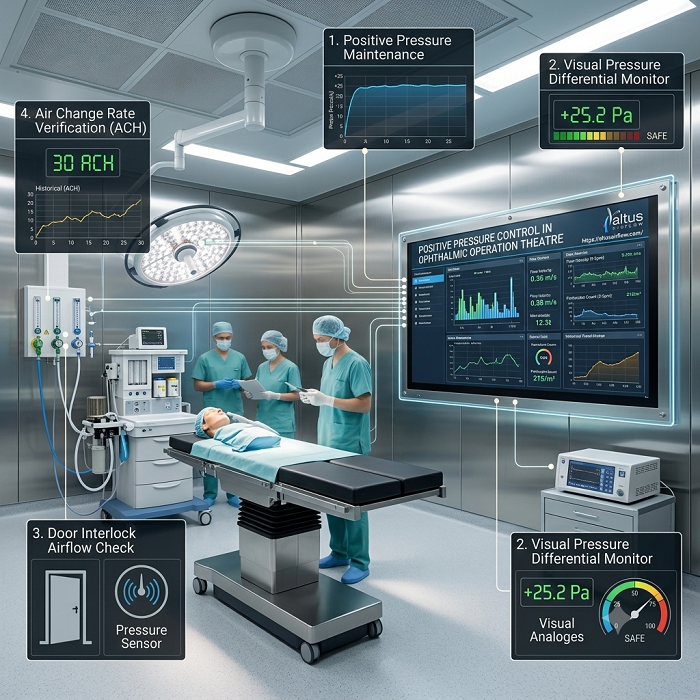
4. Positive Pressure Helps Protect the Clean Zone
Pressure control is another important contamination-control feature.
A clean surgical room is commonly maintained at a higher pressure than adjacent less-clean areas so that air tends to move outward when doors or openings are present.
NCDC guidance recommends pressure gradients that direct airflow from cleaner or ultra-clean areas toward less-clean areas, helping reduce the entry of air from less-clean zones.
For an ophthalmic OT, pressure relationships should be established according to the facility's overall ventilation design and applicable healthcare requirements.
5. Modular Construction Supports Hygienic Surfaces
The physical construction of the OT also contributes to contamination control.
Modular OT systems can incorporate smooth, sealed, non-porous surfaces that are easier to clean and maintain than surfaces containing numerous joints, cracks, or difficult-to-clean areas.
NCDC recommends hard, smooth, and non-porous OT surfaces and notes that cracks and crevices can provide places where microorganisms may remain and can make cleaning more difficult.
Appropriate wall panels, ceilings, flooring, doors, and sealed joints can therefore support the facility's cleaning and infection-prevention procedures.
6. Easy-to-Clean Interior Design
An ophthalmic OT must be designed with routine cleaning in mind.
Interior features can include:
- Smooth wall surfaces
- Sealed panel joints
- Seamless or suitably sealed flooring
- Hygienic ceiling systems
- Flush fixtures
- Properly sealed service penetrations
- Cleanable doors and hardware
Reducing unnecessary ledges and inaccessible spaces makes routine environmental cleaning more practical.
The objective is not simply to make the room visually clean but to create an environment where cleaning and disinfection procedures can be performed consistently.
7. Controlled HVAC Conditions
The laminar airflow system works together with the OT's HVAC infrastructure.
HVAC planning can regulate:
- Temperature
- Humidity
- Fresh-air supply
- Air circulation
- Pressure relationships
- Filtration
- Heat loads
NCDC's OT guidance recommends central air-conditioning and specifies an OT temperature range of 18–24°C in its ventilation and design requirements.
The exact operating conditions should be determined according to the healthcare facility's design criteria, equipment requirements, clinical needs, and applicable standards.
8. Airflow Direction Helps Protect the Surgical Area
Airflow direction is an important part of contamination control.
The objective is to move cleaner air toward the critical surgical area and then toward designated exhaust or return paths rather than allowing uncontrolled circulation.
This concept becomes particularly important when designing the relationship between:
- Supply air
- Surgical table
- Surgical microscope
- Operating lights
- Staff positions
- Equipment
- Return or exhaust outlets
Proper coordination between architectural and mechanical design helps maintain the intended airflow pattern.
9. Reduced Door Opening and Personnel Movement
People are one of the major sources of airborne particles inside an OT.
Every person entering the room can introduce particles through skin shedding, clothing, movement, and other activities. Door opening can also interfere with pressure relationships and airflow patterns.
NCDC specifically recommends keeping the number of people in the OT to a minimum and avoiding unnecessary opening and closing of doors because these activities can interfere with airflow direction.
An effective ophthalmic OT therefore combines engineering controls with operational discipline.
10. Zoning Helps Separate Clean and Less-Clean Activities
OT zoning helps control movement between areas with different cleanliness requirements.
NCDC identifies different OT zones, including outer, restricted, aseptic, and disposal zones. The cleanest zone contains the operating theatre and areas where surgical preparation and other controlled activities occur.
A well-planned ophthalmic facility can use zoning to regulate:
- Staff movement
- Patient movement
- Equipment movement
- Sterile supply movement
- Waste movement
Separating clean and disposal flows reduces unnecessary cross-traffic.
11. Proper Equipment Placement Supports Airflow
Equipment placement can directly influence airflow.
Ophthalmic OTs may contain:
- Operating microscopes
- Surgical tables
- Phacoemulsification equipment
- Surgical lights
- Patient monitoring equipment
- Medical gas outlets
- Electrical equipment
If equipment blocks or redirects the intended airflow, turbulence can occur.
For this reason, the equipment layout should be developed alongside HVAC and laminar airflow planning.
12. Environmental Monitoring Helps Maintain Conditions
A modern ophthalmic OT can incorporate monitoring systems to track important environmental parameters.
Depending on the design, monitoring may include:
- Temperature
- Relative humidity
- Differential pressure
- Airflow parameters
- Filter condition
- Particle levels
Monitoring allows facility teams to identify deviations and take corrective action.
A monitoring strategy should include defined acceptable ranges, alarm limits, calibration procedures, and documentation.
13. HEPA Filter Testing Supports System Reliability
HEPA filters require more than initial installation.
Filter integrity and system performance should be checked according to the applicable testing and maintenance program.
Testing can help identify:
- Filter damage
- Leakage
- Improper sealing
- Installation problems
- Performance deterioration
NCDC recommends regular monitoring of HEPA filter efficiency and replacement when required.
This makes preventive maintenance an essential part of long-term contamination control.
14. Validation Confirms Designed Performance
Commissioning and validation help determine whether the installed system performs according to its design requirements.
Depending on the project, testing may include:
- Airflow velocity measurements
- Airflow pattern assessment
- HEPA filter integrity testing
- Particle-count testing
- Pressure differential verification
- Temperature and humidity testing
- HVAC performance verification
Validation creates documented evidence that the engineered environment is operating within its specified parameters.
15. Cleaning and Maintenance Remain Essential
Even an advanced airflow system cannot replace proper cleaning and infection-prevention procedures.
The OT requires routine:
- Surface cleaning
- Disinfection
- Filter maintenance
- HVAC inspection
- Airflow checks
- Equipment cleaning
- Environmental monitoring
Maintenance schedules should be established based on system design, operating conditions, manufacturer recommendations, facility procedures, and monitoring results.
16. Integrated Design Provides Better Contamination Control
The strongest advantage of an Ophthalmic Modular OT With Laminar Airflow is that multiple contamination-control measures can be integrated into one coordinated environment.
These may include:
- HEPA filtration
- Unidirectional airflow
- HVAC control
- Pressure management
- Hygienic surfaces
- Controlled zoning
- Environmental monitoring
- Proper equipment placement
- Testing and commissioning
- Preventive maintenance
Each element addresses a different part of the contamination-control process.
Benefits for Ophthalmic Surgical Facilities
A properly engineered system can support:
- Better control of airborne particles
- More predictable airflow
- Improved environmental stability
- Easier cleaning
- Reduced contamination pathways
- Better workflow organization
- Improved monitoring
- Consistent maintenance procedures
It is important to understand that laminar airflow is an engineering control rather than a substitute for surgical asepsis, sterilization, environmental cleaning, hand hygiene, or other infection-prevention practices.
What Should Hospitals Consider Before Installation?
Before installing a modular ophthalmic OT with laminar airflow, hospitals should evaluate:
- OT room size and layout
- Surgical workflow
- HVAC capacity
- Required filtration
- Pressure relationships
- Airflow configuration
- Equipment placement
- Clean and dirty movement pathways
- Monitoring requirements
- Testing and commissioning
- Maintenance requirements
- Future expansion
Early coordination between clinical, architectural, HVAC, electrical, and infection-control teams can prevent design conflicts.
Conclusion
An Ophthalmic Modular OT With Laminar Airflow helps control contamination by combining HEPA-filtered airflow, controlled air movement, pressure management, hygienic modular construction, HVAC control, zoning, environmental monitoring, and regular testing and maintenance. These engineering measures work alongside cleaning, sterilization, surgical asepsis, and infection-prevention practices to support a controlled ophthalmic surgical environment. By integrating these requirements during planning and commissioning, Altus Airflow can provide modular ophthalmic OT solutions designed around the environmental, workflow, and contamination-control requirements of modern healthcare facilities.
Frequently Asked Questions
1. How does an Ophthalmic Modular OT With Laminar Airflow control contamination?
An Ophthalmic Modular OT With Laminar Airflow uses HEPA-filtered air, controlled unidirectional airflow, appropriate pressure relationships, hygienic surfaces, and environmental monitoring to help reduce airborne contamination risks.
2. Does an Ophthalmic Modular OT With Laminar Airflow use HEPA filters?
Yes. An Ophthalmic Modular OT With Laminar Airflow commonly incorporates high-efficiency filtration as part of its controlled ventilation strategy, with filter selection and performance verification based on project requirements.
3. How does laminar airflow help during ophthalmic surgery?
An Ophthalmic Modular OT With Laminar Airflow can provide a controlled, predominantly unidirectional flow of filtered air across a defined clean zone, helping limit unwanted air mixing and airborne particle movement around critical areas.
4. Does an Ophthalmic Modular OT With Laminar Airflow require HVAC integration?
Yes. An Ophthalmic Modular OT With Laminar Airflow should be integrated with appropriately designed HVAC systems to manage filtration, temperature, humidity, fresh air, airflow, and pressure relationships.
5. Can modular construction improve contamination control?
Yes. An Ophthalmic Modular OT With Laminar Airflow can use smooth, sealed, non-porous, and cleanable construction materials that support routine cleaning and reduce difficult-to-clean gaps and joints.
Read Our Previous Blog------>What are the key features of modern Laminar Airflow System Setup Company?

 English
 Arabic
 French
 Spanish
 Portuguese
 Deutsch
 Turkish
 Italiano
 Russian
 Romaian
 Portuguese (Brazil)
 Greek
Greek
