
What lighting requirements should be considered in IVF Lab Design Services?
INTRODUCTION
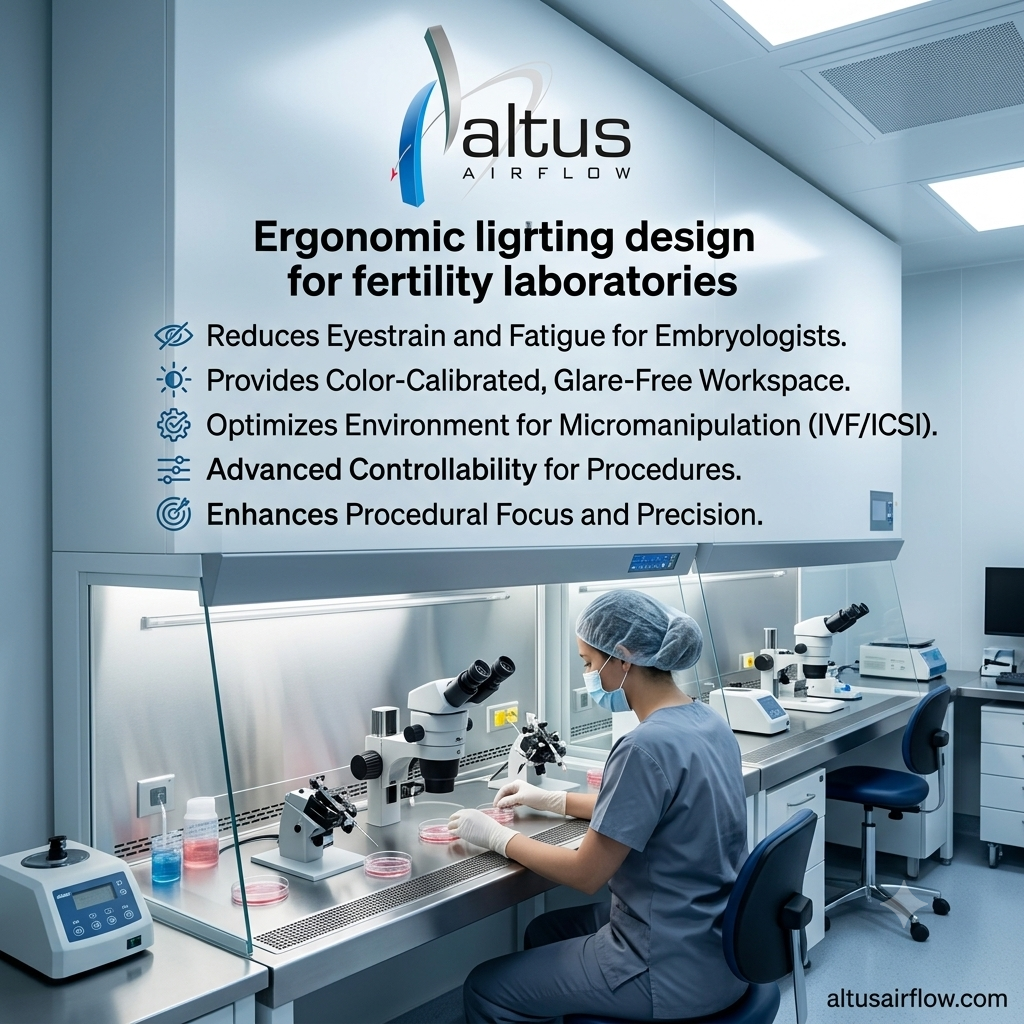
Proper lighting is an essential consideration when planning a modern fertility laboratory because it influences embryologist visibility, workplace comfort, and the conditions under which reproductive cells are handled. Professional IVF Lab Design Services should incorporate adjustable lighting, suitable task illumination, glare reduction, and strategies to minimize unnecessary light exposure to oocytes and embryos. The lighting plan must balance the precision required for procedures such as intracytoplasmic sperm injection (ICSI) with the environmental needs of embryo culture. By integrating lighting design with laboratory layout, microscope positioning, HVAC systems, and equipment requirements, fertility clinics can establish an efficient, comfortable, and well-controlled working environment.
Why Is Lighting Important in IVF Laboratory Design?
An IVF laboratory supports delicate procedures involving sperm, oocytes, and embryos. Embryologists need sufficient visibility to identify structures, manipulate reproductive cells, prepare culture dishes, and document laboratory activities accurately.
However, brighter lighting is not always better. Excessive or poorly directed light may create glare, cause visual fatigue, interfere with microscope viewing, and increase unnecessary exposure of reproductive material to light.
The 2026 recommendations from the European Society of Human Reproduction and Embryology (ESHRE) emphasize appropriate environmental lighting, ergonomic working conditions, and minimizing exposure of oocytes and embryos to potentially harmful environmental factors. The ESHRE recommendations on good practice in the IVF laboratory provide an important reference for planning laboratory conditions.
An effective lighting strategy should therefore support three priorities:
-
Accurate visualization during laboratory procedures.
-
Comfortable and safe working conditions for embryologists.
-
Controlled light exposure during the handling and culture of reproductive cells.
1. Select Adjustable and Dimmable Lighting
One of the most important considerations in IVF laboratory lighting is adjustability. Different laboratory activities require different illumination levels, and the lighting system should accommodate these changing needs.
For example, general preparation work may require comfortable ambient lighting, while microscope-based procedures may require lower surrounding illumination to improve viewing conditions.
An IVF laboratory should consider dimmable lighting that allows staff to adjust illumination according to the task being performed.
Important features include:
-
Smooth adjustment of light intensity.
-
Stable illumination without distracting flicker.
-
Easy-to-operate controls.
-
Separate controls for different work zones.
-
Compatibility with microscopes and other sensitive equipment.
-
The ability to reduce ambient light during procedures when appropriate.
Dimmable systems also help laboratories avoid unnecessary illumination when workstations are not in use. The final lighting arrangement should be evaluated under actual operating conditions rather than selected solely from product specifications.
2. Minimize Unnecessary Light Exposure to Oocytes and Embryos
Light exposure is an important consideration when handling reproductive cells. Current ESHRE guidance recommends minimizing exposure to light and specifically reducing blue-light exposure as much as possible.
An IVF laboratory should therefore avoid unnecessary illumination of exposed oocytes and embryos during procedures. This does not mean that every procedure must take place in darkness. Instead, lighting should be planned to provide sufficient visibility while limiting avoidable exposure.
Practical design measures include:
-
Using adjustable ambient lighting.
-
Providing focused illumination only where required.
-
Avoiding direct light sources over embryo-handling workstations when unnecessary.
-
Positioning workstations to reduce stray light.
-
Considering suitable microscope illumination settings.
-
Using validated equipment configurations that support controlled viewing conditions.
-
Training staff to minimize unnecessary exposure during handling.
Lighting decisions should be coordinated with laboratory protocols, microscope requirements, and the recommendations of equipment manufacturers.
3. Provide Suitable Task Lighting for Precision Procedures
IVF procedures require detailed visual assessment and precise manipulation. General room lighting alone may not provide the best conditions for every task.
Task lighting provides focused illumination at specific workstations. It can support procedures such as sample preparation, dish identification, documentation, and other activities that require detailed visual inspection.
When planning task lighting, the consultant should consider:
-
The type of procedure performed at each workstation.
-
The required viewing distance and direction.
-
The position of microscopes and micromanipulators.
-
The possibility of shadows from staff or equipment.
-
Whether illumination can be adjusted independently.
-
The ease of cleaning and maintaining the lighting fixtures.
Task lighting should complement, rather than replace, suitable ambient illumination. It must also be arranged so that it does not shine directly into an operator's eyes or create unwanted reflections on microscope screens and laboratory surfaces.
For embryo-handling procedures, focused illumination should be carefully controlled to avoid unnecessary light exposure.
4. Integrate Lighting With Microscope and ICSI Workstations
Microscopes and micromanipulation systems are central to many IVF laboratory procedures. Their placement directly influences the lighting requirements of the workstation.
During ICSI, an embryologist uses a microscope and micromanipulation equipment to inject a sperm cell into an oocyte. The lighting arrangement must support clear visualization without introducing unnecessary glare or disrupting the procedure.
A well-planned workstation should consider:
-
Microscope illumination controls.
-
Ambient light levels around the instrument.
-
Screen brightness and reflections.
-
Operator eye position and viewing angle.
-
The placement of micromanipulators and supporting equipment.
-
Access to controls without interrupting work.
-
Ergonomic seating and bench height.
Microscope illumination should be adjusted according to the instrument's intended use and the laboratory's validated procedure. The room lighting should not be treated as a substitute for the microscope's own optical and illumination settings.
An integrated design reduces awkward movements and helps maintain consistent working conditions during precision procedures.
5. Reduce Glare, Reflections, and Harsh Shadows
Glare can make it difficult to distinguish fine details, particularly when embryologists alternate between microscopes, computer screens, and work surfaces.
Reflections from glossy benches, glass partitions, metal surfaces, or computer displays can cause visual discomfort. Poorly positioned ceiling lights may also create shadows over important work areas.
To address these problems, IVF Lab Design Services should include a lighting layout that considers both the position of fixtures and the reflectivity of surrounding materials.
Recommended design considerations include:
-
Positioning luminaires to avoid direct glare.
-
Selecting suitable diffusers and light distribution patterns.
-
Avoiding unnecessary high-gloss finishes near critical workstations.
-
Providing even ambient illumination.
-
Assessing shadows created by equipment and personnel.
-
Positioning screens to reduce reflected light.
-
Testing lighting from the seated operator's actual viewing position.
A mock-up or on-site assessment before final handover can help identify glare and shadow problems that might not be obvious on a floor plan.
6. Choose Suitable LED Lighting Systems
LED lighting is commonly used in modern laboratory environments because it can offer energy efficiency, long service life, and flexible control options. However, not every LED fixture is automatically suitable for an IVF laboratory.
The selection should consider optical performance, heat output, flicker characteristics, colour rendering, dimming compatibility, cleanability, and the fixture's potential to create glare.
Useful features may include:
-
Dimmable output.
-
Stable light quality across the operating range.
-
Suitable colour rendering for visual tasks.
-
Low-glare optical design.
-
Appropriate fixture housings for the laboratory environment.
-
Compatibility with lighting control systems.
-
Access for cleaning and maintenance.
Colour temperature should be selected according to visual comfort and the tasks performed in each area. It should not be assumed that a particular colour temperature alone protects embryos from light-related effects. Where light spectrum is a concern, the laboratory should evaluate the actual spectral characteristics of the source and follow relevant professional guidance.
7. Plan Different Lighting Conditions for Different Laboratory Zones
An IVF laboratory contains several functional areas, and a single lighting specification may not be suitable for all of them.
A lighting plan should reflect the activities carried out in each zone.
Embryology and embryo-handling areas: Provide controllable ambient lighting and carefully managed task illumination to support precise work while limiting unnecessary exposure.
ICSI and micromanipulation workstations: Coordinate room lighting with microscope illumination, screen position, and operator ergonomics.
Sperm preparation areas: Provide sufficient visibility for sample identification, preparation, and documentation, while accounting for microscope use where applicable.
Cryopreservation areas: Ensure adequate visibility for safe handling, labeling, and traceability, while coordinating lighting with equipment instructions and the laboratory's procedures.
Preparation and storage areas: Provide sufficient illumination for reading labels, identifying materials, and handling supplies safely.
Administrative and reporting areas: Support computer work and document review with appropriate illumination and reduced screen glare.
These zones may share a common lighting control platform, but separate controls can help staff create suitable conditions for each activity.
8. Coordinate Lighting With HVAC and Laboratory Equipment
Lighting fixtures can affect the thermal environment, particularly in a tightly controlled laboratory with sensitive equipment. Heat released by luminaires may contribute to the cooling load and should be considered during HVAC design.
The lighting and mechanical engineering teams should coordinate fixture placement, ceiling space, air distribution, and maintenance access.
Key considerations include:
-
Selecting fixtures with appropriate heat output.
-
Avoiding conflicts between luminaires and air-supply diffusers.
-
Maintaining access to HVAC components and filters.
-
Preventing fixture placement from interfering with airflow patterns.
-
Coordinating lighting with incubators, microscopes, and monitoring equipment.
-
Assessing temperature stability under normal operating conditions.
Lighting should not compromise the laboratory's temperature and humidity controls. After installation, the integrated systems should be tested to confirm that they perform as intended.
9. Consider Ergonomics and Staff Visual Comfort
Embryologists may spend extended periods working with microscopes, computer screens, and small laboratory materials. Poor lighting can contribute to visual fatigue and discomfort, especially when combined with awkward posture or prolonged concentration.
The ESHRE recommendations identify workplace ergonomics and operator comfort as important aspects of IVF laboratory design.
An effective lighting plan should therefore consider:
-
The height and position of the microscope eyepieces.
-
Adjustable seating and suitable bench height.
-
The relationship between ambient and task lighting.
-
Screen brightness and contrast.
-
Avoidance of direct glare.
-
Smooth transitions between differently illuminated work areas.
-
Convenient placement of lighting controls.
These factors support a more comfortable working environment and can help reduce distractions during detailed laboratory procedures.
10. Establish Lighting Commissioning and Maintenance Procedures
Lighting design should be verified after installation. Commissioning helps confirm that the system provides the intended illumination, control functionality, and operating conditions.
A commissioning plan may include:
-
Measuring illuminance at representative work surfaces.
-
Checking illumination uniformity and shadow formation.
-
Assessing glare at microscope and computer workstations.
-
Testing dimming controls and zone settings.
-
Verifying compatibility with critical equipment.
-
Confirming that fixtures can be cleaned and maintained safely.
-
Documenting the final settings and maintenance requirements.
Illuminance values should be selected according to the task, applicable requirements, and professional lighting design standards. There is no single lux value that is appropriate for every IVF laboratory workstation.
Maintenance procedures should address fixture cleaning, replacement of defective components, control-system checks, and reassessment after significant changes to the layout or equipment.
Frequently Asked Questions
1. What lighting features should IVF Lab Design Services include?
IVF Lab Design Services should consider adjustable ambient lighting, dimmable task lighting, glare reduction, suitable microscope illumination, and strategies to minimize unnecessary light exposure to oocytes and embryos.
2. Why is dimmable lighting important in IVF laboratories?
IVF Lab Design Services can incorporate dimmable lighting so embryologists can adjust ambient illumination for different procedures, improve visual comfort, and limit unnecessary light exposure during reproductive cell handling.
3. How can IVF Lab Design Services reduce blue-light exposure?
IVF Lab Design Services can address blue-light exposure by evaluating the light sources used, providing controllable illumination, coordinating room lighting with microscope settings, and following current professional guidance to minimize unnecessary exposure.
4. Is LED lighting suitable for IVF laboratories?
IVF Lab Design Services may specify LED systems when their dimming performance, spectral characteristics, glare control, heat output, and compatibility with laboratory procedures meet the facility's requirements.
5. How should lighting be tested before an IVF laboratory begins operating?
IVF Lab Design Services should include commissioning checks for illuminance, uniformity, glare, dimming controls, workstation visibility, and coordination with HVAC and critical equipment.
Conclusion
Lighting is a functional part of IVF laboratory design, not simply a finishing detail. The right approach combines adjustable illumination, focused task lighting, reduced glare, controlled light exposure, ergonomic workstation planning, and careful coordination with HVAC and laboratory equipment. Commissioning and ongoing maintenance help ensure that these features continue to perform as intended. For specialized laboratory planning, engineering, and turnkey infrastructure solutions, Altus Airflow supports fertility clinics in developing IVF laboratory environments tailored to their operational and technical requirements.
Read Our Previous Blog------>How can IVF Lab Design Consultant minimize the risk of cross-contamination?

 English
 Arabic
 Spanish
 Portuguese
 Deutsch
 Turkish
 Dutch
Dutch
 Italiano
 Russian
 Romaian
 Portuguese (Brazil)
 Greek
Greek
