
The Future of Data Center Cooling: Immersion Technology Takes Center Stage
Immersion Cooling Market: Size, Share, Trends, and Forecast (2026–2034)
The global immersion cooling market is gaining momentum as data centers, artificial intelligence (AI) infrastructure, and high-performance computing (HPC) facilities require advanced thermal management solutions. Immersion cooling uses specialized dielectric fluids to dissipate heat from electronic components, helping maintain equipment performance while reducing dependence on conventional cooling systems. The growing power density of servers and demand for efficient computing infrastructure are supporting market expansion.
Request Sample: http://straitsresearch.com/report/immersion-cooling-market/request-sample
Market Overview
Immersion cooling is a thermal management technique in which electronic components or equipment are submerged in a specialized dielectric liquid to remove heat. The technology is used in data centers, high-performance computing systems, and cryptocurrency mining equipment to improve cooling efficiency and manage heat generated by intensive computing workloads.
The immersion cooling market includes single-phase and two-phase systems, which serve different thermal management requirements. Applications span high-performance computing, artificial intelligence, edge computing, and cryptocurrency mining. Cooling fluids include mineral oil, synthetic fluids, and fluorocarbon-based fluids.
Market Size and Forecast
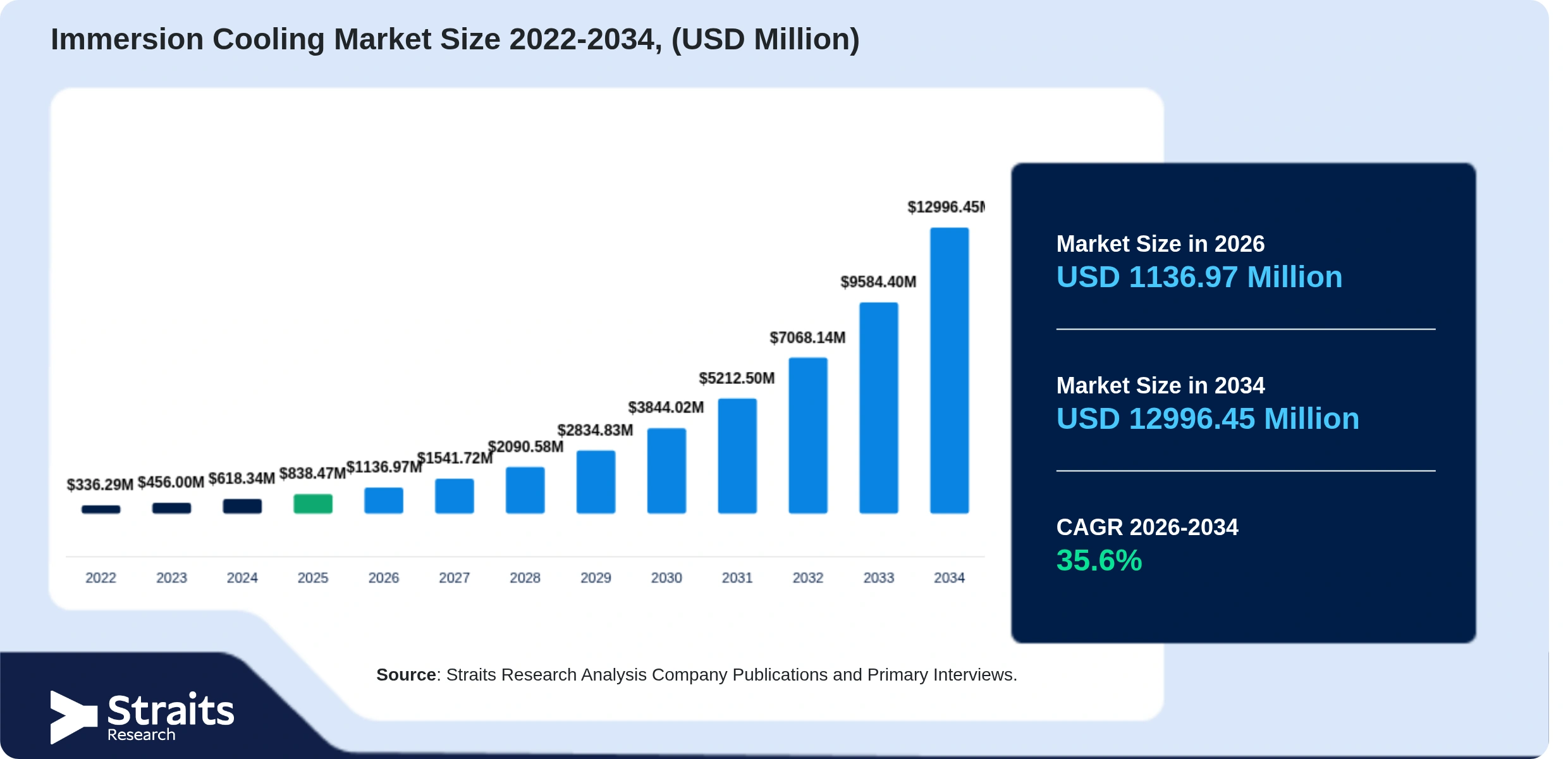
The global immersion cooling market was valued at USD 838.47 million in 2025. It is projected to increase from USD 1,136.97 million in 2026 to USD 12,996.45 million by 2034, registering a CAGR of 35.6% during the forecast period from 2026 to 2034.
North America held the largest regional share at 38.4% in 2025, supported by demand for advanced data center cooling infrastructure. Asia Pacific is projected to be the fastest-growing region, with a CAGR of 28.41% over the forecast period.
Market Drivers
Growing Data Center Power Density
The higher power density of data centers is strengthening demand for advanced cooling technologies. High-performance processors and densely configured servers generate substantial heat within limited rack space, creating thermal management requirements that conventional air-cooling systems may struggle to address. Immersion cooling enables direct heat removal from computing equipment, supporting stable operating temperatures in high-density facilities. The deployment of high-density server racks in hyperscale data centers is therefore creating demand for specialized immersion cooling tanks and infrastructure.
Expansion of AI Computing Infrastructure
The expansion of AI and high-performance computing infrastructure is generating demand for cooling systems capable of managing concentrated heat loads. AI training and inference workloads rely on powerful GPUs and accelerators that produce substantial heat during continuous computing operations. Immersion cooling can help manage these thermal requirements while supporting hardware performance and operational stability. The deployment of GPU-based servers in large-scale AI facilities is creating opportunities for suppliers of cooling tanks, dielectric fluids, and related equipment.
Demand for Energy-Efficient Data Center Operations
Data center operators are seeking cooling technologies that reduce electricity consumption and improve facility efficiency. Immersion cooling reduces reliance on conventional air-conditioning equipment and cooling fans, making it relevant to facilities aiming to lower cooling-related energy use. This requirement supports adoption across data centers handling intensive computing workloads.
Market Challenges
High Initial Infrastructure Requirements
Immersion cooling requires specialized tanks, dielectric fluids, and supporting infrastructure. The need to integrate these components into existing data center operations can create implementation requirements for operators considering a transition from conventional cooling systems. These infrastructure considerations may influence adoption decisions, particularly when facilities evaluate system compatibility and deployment requirements.
Equipment and Fluid Compatibility
Immersion cooling systems depend on dielectric fluids with suitable thermal performance, electrical insulation, material compatibility, and long-term stability. Cooling fluid selection must align with the equipment and operating requirements of each installation. These considerations create demand for application-specific fluid formulations and system designs that support reliable operation.
Market Opportunities
Development of Advanced Dielectric Fluids
Innovation in dielectric fluid formulations is creating opportunities for cooling fluid manufacturers. Products with improved thermal conductivity, electrical insulation, material compatibility, and long-term stability can support reliable cooling of high-density computing equipment. Application-specific coolants can also help improve heat transfer and reduce maintenance requirements in data center environments.
Integration of Waste Heat Recovery Systems
The integration of heat recovery infrastructure with immersion cooling systems offers opportunities to improve data center energy management. Warm dielectric fluid leaving server tanks can transfer captured heat to secondary loops for facility heating, industrial processes, and other thermal applications. These integrated solutions can support heat reuse while improving the overall efficiency of data center facilities.
Market Segmentation
By Type
Single-phase immersion cooling accounted for the largest market share of 68.7% in 2025. Its simpler system design, lower maintenance requirements, and suitability for large-scale data center deployments support its leading position. Established adoption and operational efficiency make it a preferred option for many high-density computing environments.
Two-phase immersion cooling is projected to record the highest CAGR of 26.28%. Its heat transfer capabilities and ability to manage high thermal loads support adoption in advanced computing environments. Demand for cooling solutions suited to AI servers and high-performance computing is contributing to this segment's growth.
By Application
High-performance computing held the largest application share at 34.6% in 2025. Computationally intensive workloads and high-density server configurations generate substantial heat, requiring reliable thermal management. Applications such as scientific research, simulation, and enterprise computing support demand for immersion cooling.
Artificial intelligence is projected to be the fastest-growing application segment, registering a CAGR of 29.34%. AI training and inference workloads require high-performance GPUs and accelerators, increasing the thermal requirements of computing infrastructure. These requirements are encouraging data center operators to consider immersion cooling for efficient heat management.
By Cooling Fluid
Mineral oil accounted for the largest cooling fluid share at 42.5% in 2025. Its thermal stability, electrical insulation properties, availability, and cost advantages support its use in immersion cooling systems. These characteristics make mineral oil a widely adopted option for data center cooling applications.
Fluorocarbon-based fluids are projected to grow at the highest CAGR of 26.97%. Their heat transfer characteristics and dielectric properties support their use in advanced two-phase cooling systems. Demand for efficient thermal management in high-density computing infrastructure is supporting this segment's expansion.
Regional Analysis
North America
North America dominated the immersion cooling market with a share of 38.4% in 2025. Growing data center electricity requirements in the U.S. and Canada are supporting demand for advanced thermal management technologies.
In the U.S., the Department of Energy's 2026 data center energy assessment indicates that data centers could account for 9.5%–15.3% of total electricity consumption by 2030, compared with approximately 4.7% in 2024. This projected demand is strengthening the need for energy-efficient cooling solutions for AI and computing workloads.
In Canada, the Canada Energy Regulator projects additional data center electricity demand of 1.5 GW by 2030 under its baseline scenario. Its higher-growth scenario reaches 2.7 GW by 2030 and 12 GW by 2050, supporting demand for advanced cooling infrastructure.
Asia Pacific
Asia Pacific is expected to be the fastest-growing regional market, registering a CAGR of 28.41% from 2026 to 2034. Data center expansion and investment in digital infrastructure across Japan, China, and India are supporting regional demand.
In Japan, maximum power demand from new and expanded data centers and semiconductor plants is projected to reach approximately nine times the FY2025 level by FY2030. In China, energy-efficiency targets and digital infrastructure plans promoting liquid cooling and server racks exceeding 100 kW are creating opportunities for immersion cooling. In India, projected data center electricity demand of 13.56 GW by FY2031–32 and adoption of advanced liquid-cooling technologies are supporting market development.
Europe
Europe accounted for 27.6% of the immersion cooling market in 2025. Expanding data center capacity and electricity consumption are supporting demand for efficient cooling infrastructure.
In the U.K., data center capacity could reach 5.2 GW by 2030, with annual electricity consumption exceeding 20 TWh. The U.K. Government's Compute Evidence Annex notes that immersion cooling can reduce cooling-related energy consumption by up to 30% compared with traditional air cooling. In Germany, data center electricity consumption is projected to increase from 20 TWh in 2024 to 31 TWh by 2030, creating additional demand for energy-efficient cooling systems.
Middle East and Africa and Latin America
The Middle East and Africa and Latin America are also included in the regional scope of the immersion cooling market. Market coverage across these regions reflects the global application of immersion cooling across data centers, high-performance computing facilities, and other computing environments.
Key Players in the Immersion Cooling Market
The immersion cooling market is moderately fragmented, with competition among cooling equipment manufacturers, data center infrastructure providers, thermal management specialists, dielectric fluid manufacturers, and specialized technology companies. The five leading companies—LiquidStack, Green Revolution Cooling, Submer, Asperitas, and Midas Green Technologies—are estimated to collectively account for approximately 22–25% of the global market. This is an indicative estimate, as their exact combined market share is not publicly disclosed.
Key companies operating in the immersion cooling market include:
-
LiquidStack Holding B.V. (Netherlands)
-
Green Revolution Cooling, Inc. (U.S.)
-
Submer Technologies, S.L. (Spain)
-
Asperitas B.V. (Netherlands)
-
Midas Green Technologies, Inc. (U.S.)
-
Iceotope Technologies Limited (United Kingdom)
-
LiquidCool Solutions, Inc. (U.S.)
-
DUG Technology Ltd. (Australia)
Companies compete through cooling efficiency, thermal performance, system reliability, fluid quality, equipment durability, scalability, and compatibility with existing data center infrastructure. Emerging providers also focus on modular systems, advanced dielectric fluids, improved heat transfer technologies, and solutions designed for AI and edge computing applications.
Recent Industry Developments
-
February 2026: Infosys expanded its strategic collaboration with ExxonMobil to advance immersion cooling solutions for AI-driven data centers. The collaboration focused on using ExxonMobil Data Center Immersion Fluids alongside Infosys' AI and cloud infrastructure platforms to improve thermal management, energy efficiency, and sustainability.
-
February 2026: Valeo and 2CRSi launched an outdoor autonomous immersion-cooled edge data center solution for Indian telecom operators. The solution combines thermal management expertise with high-performance server technologies to support AI and 5G applications.
-
January 2026: Immersion cooling technology providers continued expanding solutions for AI data centers. Industry participants focused on improving liquid cooling architectures, immersion fluids, and integrated systems for high-density computing workloads.
Conclusion
The immersion cooling market is positioned for substantial growth as data center power density, AI computing workloads, and high-performance computing infrastructure increase demand for advanced thermal management. Single-phase immersion cooling currently leads the market, while artificial intelligence represents the fastest-growing application segment. Mineral oil remains the leading cooling fluid, supported by its thermal stability and electrical insulation properties.
North America held the largest regional share in 2025, while Asia Pacific is projected to record the fastest regional growth through 2034. Developments in dielectric fluid technology and waste heat recovery integration are creating additional opportunities for market participants. The market is projected to reach USD 12,996.45 million by 2034, at a CAGR of 35.6% during 2026–2034.
Report: http://straitsresearch.com/report/immersion-cooling-market
 English
 Arabic
 French
 Spanish
 Portuguese
 Turkish
 Dutch
 Italiano
 Russian
 Romaian
 Portuguese (Brazil)
 Greek
